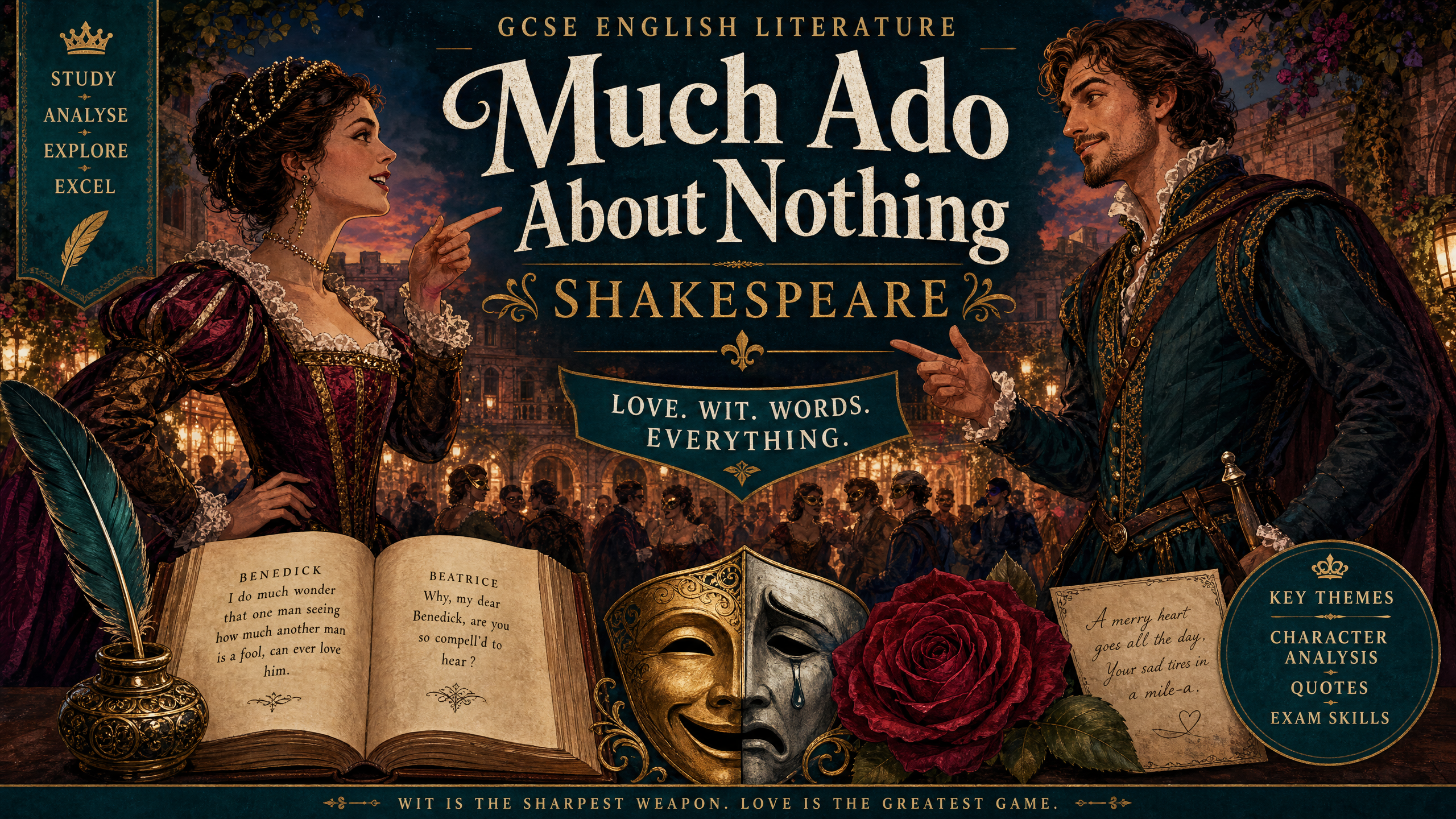
Much Ado About Nothing
Dive into Shakespeare's sparkling comedy of wit, warfare, and weddings. 'Much Ado About Nothing' offers a brilliant exploration of deception, gender politics, and honour that consistently rewards perceptive, critical analysis in the exam.
Study Notes
Overview
'Much Ado About Nothing' (c. 1598) is a masterclass in comic structure that simultaneously exposes the dark underbelly of Elizabethan society. Set in Messina, the play revolves around two contrasting love plots: the witty, reluctant romance of Beatrice and Benedick, and the conventional, near-tragic courtship of Claudio and Hero. Examiners look for candidates who can move beyond the comedy to analyse how Shakespeare uses deception (both benevolent and malevolent) to explore profound themes of honour, gender inequality, and the unreliability of human perception (the 'noting' motif). High-level responses will consistently link Shakespeare's dramatic methods to the patriarchal context of the era.
Plot/Content Overview
Act 1: Don Pedro and his soldiers arrive in Messina. Claudio falls for Hero, while Beatrice and Benedick resume their 'merry war' of wits. Don Pedro offers to woo Hero on Claudio's behalf.
Act 2: At a masked ball, Don John maliciously tricks Claudio into thinking Don Pedro is wooing Hero for himself, but the misunderstanding is quickly resolved. Don Pedro proposes a benevolent plot to trick Beatrice and Benedick into falling in love.
Act 3: Both Beatrice and Benedick are successfully tricked by staged conversations. Meanwhile, Don John hatches a malevolent plot: his man Borachio will woo Margaret at Hero's window, making it appear Hero is unfaithful. Dogberry and the Watch arrest Borachio, but fail to communicate this to Leonato.
Act 4: The Climax. Claudio publicly shames Hero at the altar. She faints and is presumed dead on the Friar's advice. Beatrice demands Benedick prove his love by killing Claudio.
Act 5: Dogberry's men reveal the truth. A repentant Claudio agrees to marry Leonato's 'niece' (who is revealed to be Hero). Beatrice and Benedick publicly declare their love. Don John is captured, and the play ends in a celebratory dance.
Themes
Theme 1: Deception and 'Noting'
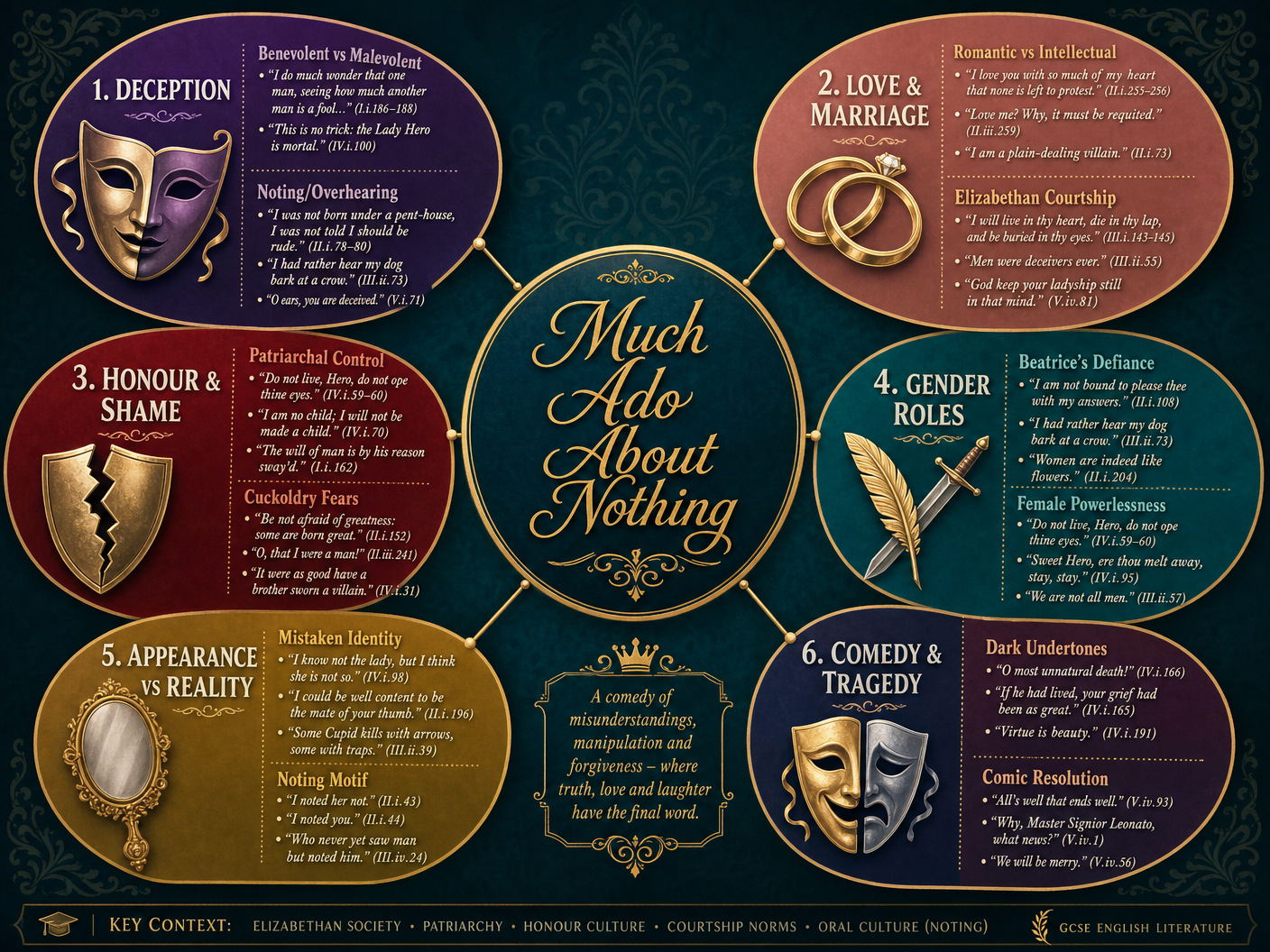
Deception drives the entire plot, but Shakespeare carefully distinguishes between benevolent deception (the plot to unite Beatrice and Benedick) and malevolent deception (Don John's plot to ruin Hero). The play's title puns on 'noting' (overhearing/observing), highlighting how easily human perception is manipulated.
Key Quotes:
- "I noted her not, but I looked on her." (Claudio, I.i) - Analysis: Introduces the distinction between merely looking and truly perceiving, foreshadowing Claudio's later fatal misjudgement.
- "Any bar, any cross, any impediment will be medicinable to me." (Don John, II.ii) - Analysis: Establishes Don John's motiveless malignity; his deception is purely destructive, contrasting with Don Pedro's constructive trickery.
Theme 2: Honour and Shame
In the patriarchal society of Messina, male honour is based on military valour and public reputation, while female honour is entirely dependent on chastity. The devastating speed with which Leonato turns on Hero demonstrates how fragile female status was in Elizabethan culture.
Key Quotes:
- "She is but the sign and semblance of her honour." (Claudio, IV.i) - Analysis: The sibilance highlights Claudio's disgust. He values the 'sign' (appearance) of honour over Hero's actual humanity.
- "Do not live, Hero, do not ope thine eyes." (Leonato, IV.i) - Analysis: The repetition of 'do not' emphasises Leonato's absolute rejection. He prefers a dead daughter to a dishonoured one, reflecting extreme patriarchal values.
Theme 3: Gender Roles and Rebellion
Shakespeare explores the limitations placed on women through the contrast between the silent, compliant Hero and the outspoken, rebellious Beatrice. However, even Beatrice's verbal power is ultimately shown to be insufficient in a male-dominated world.
Key Quotes:
- "I had rather hear my dog bark at a crow than a man swear he loves me." (Beatrice, I.i) - Analysis: Animalistic imagery underscores her fierce independence and rejection of conventional romantic submission.
- "O God, that I were a man! I would eat his heart in the market-place." (Beatrice, IV.i) - Analysis: The visceral, violent imagery reveals her absolute frustration. Despite her wit, she recognises her physical and social powerlessness as a woman.
Character Analysis
Beatrice
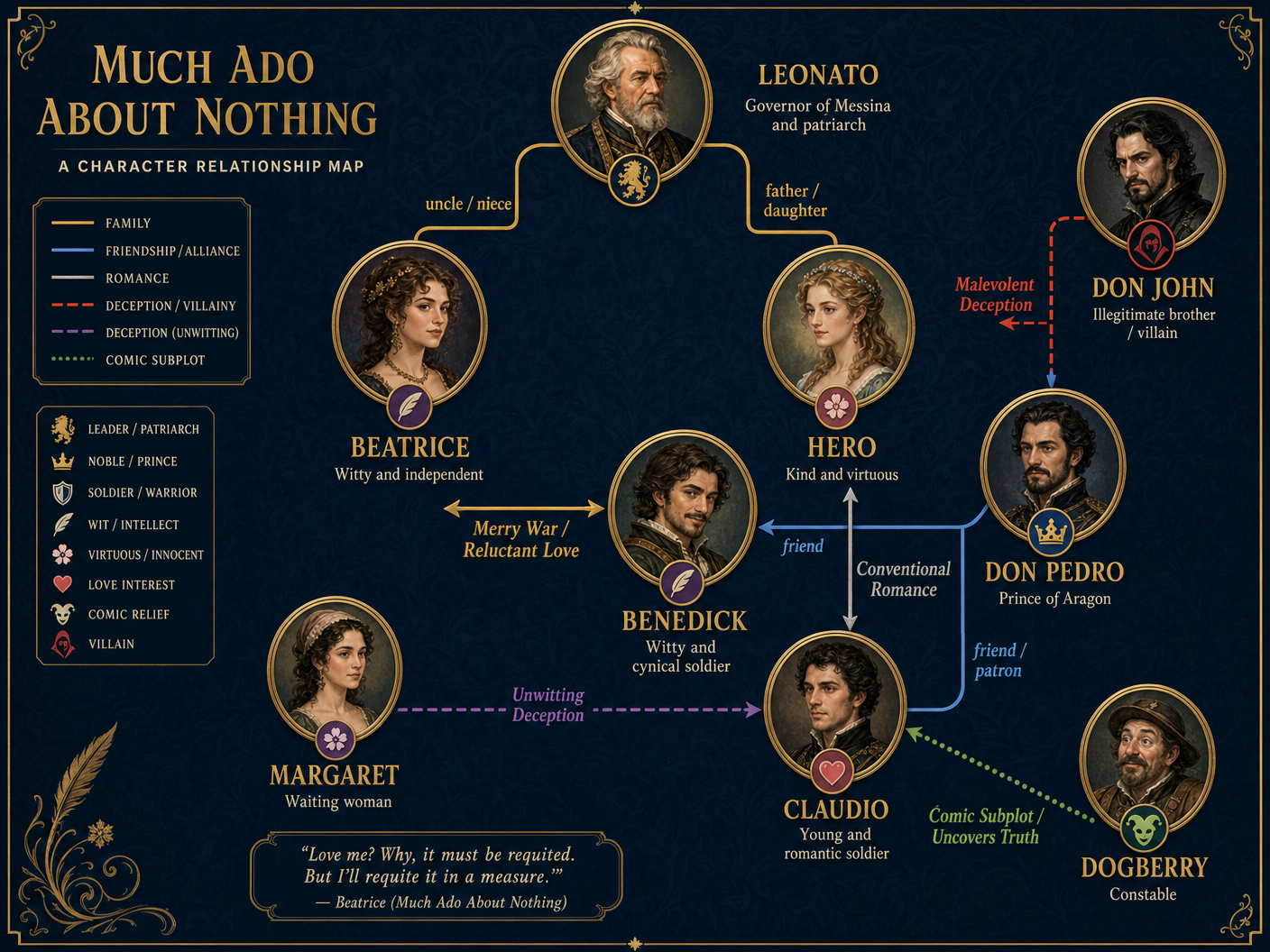
Role: The witty, unconventional heroine who challenges patriarchal norms.
Key Traits: Intelligent, fiercely independent, secretly vulnerable, fiercely loyal.
Character Arc: Moves from defensive cynicism about love to accepting vulnerability and emotional connection with Benedick.
Essential Quotes:
- "A bird of my great's uncle's that we have taught to speak." (Benedick about Beatrice)
- "Kill Claudio."
- "Taming my wild heart to thy loving hand."
Benedick
Role: The cynical soldier who becomes a devoted lover.
Key Traits: Arrogant, witty, deeply concerned with male camaraderie, ultimately courageous.
Character Arc: Shifts his allegiance from the male military world (Don Pedro/Claudio) to the domestic, female world of Beatrice.
Essential Quotes:
- "I will live a bachelor."
- "When I said I would die a bachelor, I did not think I should live till I were married."
- "Enough, I am engaged."
Claudio
Role: The conventional romantic lead whose flaws expose societal issues.
Key Traits: Impressionable, status-conscious, quick to anger, deeply concerned with reputation.
Character Arc: Moves from idealised infatuation to brutal rejection, and finally to repentance and a more mature understanding of love.
Essential Quotes:
- "Can the world buy such a jewel?"
- "Give not this rotten orange to your friend."
- "Yet sinned I not / But in mistaking."
Writer's Methods
Prose vs Verse: Shakespeare primarily uses prose for Beatrice and Benedick's witty banter, creating a fast-paced, realistic, and intellectual tone. Verse (iambic pentameter) is reserved for moments of high emotion or formality, such as Claudio's denunciation of Hero, elevating the tragic tension.
Dramatic Irony: The audience is frequently placed in a position of superior knowledge (e.g., knowing the Watch has arrested Borachio while the wedding proceeds). This creates both comic anticipation and intense dramatic tension.
Structural Parallels: The play is built on contrasting scenes. The benevolent gulling of Benedick (II.iii) is immediately followed by the benevolent gulling of Beatrice (III.i), highlighting their equality. This contrasts sharply with the malevolent deception of Claudio.
Context
Patriarchy and Coverture: In Elizabethan England, women were legally under the control of their fathers or husbands (coverture). Hero's silence and Leonato's absolute authority over her marriage reflect this historical reality.
Cuckoldry: The Elizabethan male obsession with being cuckolded (having an unfaithful wife) permeates the play. The constant jokes about 'horns' reflect a deep-seated societal anxiety about female sexuality and male reputation.
The Courtier: Castiglione's influential book 'The Courtier' outlined the ideal Renaissance man and woman. Benedick and Beatrice subvert these ideals, while Claudio and Hero initially seem to embody them perfectly.
Visual Resources
2 diagrams and illustrations
Interactive Diagrams
1 interactive diagram to visualise key concepts
Conceptual Flow Outline
The Structural Arc of Deception in Much Ado About Nothing
Worked Examples
2 detailed examples with solutions and examiner commentary
Practice Questions
Test your understanding — click to reveal model answers
Starting with the extract where Don John says 'I am a plain-dealing villain' (Act 1 Scene 3), explore how Shakespeare presents the theme of malevolence and villainy in the play.
Hint: Consider Don John's status as an illegitimate brother. How does his straightforward villainy contrast with the 'benevolent' trickery of the other characters?
How does Shakespeare use the character of Claudio to explore the flaws of Elizabethan society? Write about:
- how Claudio behaves in the play
- what his behaviour reveals about the society he lives in
Hint: Don't just write 'Claudio is bad'. Look at how his obsession with honour and his quickness to believe Don John over his own fiancée reflect the patriarchal values of his world.
Explore the significance of the 'noting' motif (eavesdropping, observing, and misinterpreting) in Much Ado About Nothing.
Hint: Connect 'noting' to the broader theme of Appearance vs Reality. Look at both the comic noting (the orchard scenes) and the tragic noting (the window scene).
Starting with the extract where Dogberry instructs the Watch (Act 3 Scene 3), explore how Shakespeare uses comedy to highlight serious themes in the play.
Hint: Dogberry is funny, but what is Shakespeare saying about the noble characters if the foolish Watchmen are the ones who solve the crime?